Do you have to pose for your wedding video?
When filming blends into the day, and when you may want a little direction
A professional wedding videographer does not need to interrupt your day to make a good film. Some moments require quiet observation, others benefit from a little guidance, and any more deliberate scene should be something you actually want to do. You can agree to being directed of course, decline it, or change your mind on the day itself: none of those choices should turn your wedding into a film set.
I’m Meryll de Gordon, a destination wedding filmmaker based in Provence, France. Before filming, I try to understand how comfortable each of you feels around a camera, which moments matter most and where you would prefer privacy. During the wedding, I stay available to suggest an idea when it makes sense, but I can also drop it immediately. Here is what that means in practice, from the morning preparations to the evening reception.
Before the wedding: understanding your comfort with the camera
The conversations we have before your wedding are not simply about the schedule. I want to understand how you are together: Are you naturally expressive? Do you enjoy having photographs taken, or does the thought of a camera nearby make you tense? Perhaps one of you likes being filmed and the other would rather forget I’m there. Those details change how I work.
I also ask about sensitive moments, family dynamics and personal requests. Maybe you want your vows recorded but would prefer the morning to remain private. Maybe you love the idea of a carefully framed scene but dislike formal poses. There is no correct answer to any of this. My role is to understand where you feel comfortable, not to persuade you to be someone else for the film.
If I have a particular scene or activity in mind, we can discuss it in advance. We might decide to include it, keep it as an option or forget it entirely. That way, any creative suggestion has a place in the conversation before it has a place in your wedding. For the wider planning process, you can also see how I prepare a wedding film with my couples.
Getting ready: filming around the morning, not rearranging it
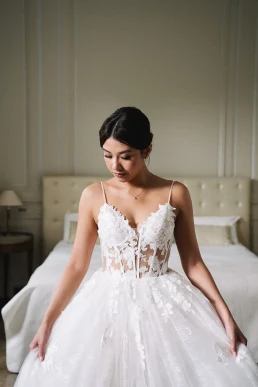
Preparations are often a mixture of small routines, people coming in and out, and moments that cannot be planned. I look for these without asking everyone to stop what they are doing. If someone helps with a dress, adjusts a tie or shares a joke, it can be filmed as it happens. I do not need them to repeat the gesture for a better angle.
There may be times when I notice a calmer space or better light and can suggest moving for a short shot, if you have said you are open to that kind of direction. It is a possibility, not an instruction. If you would rather stay with your friends, continue getting ready or have a few minutes alone, that takes priority. If there is too much happening in a room, I can change my position or focus on something else. If you say “not now,” I can step back. That is one reason getting to know you beforehand matters: it helps me recognise when a suggestion would be welcome and when it would be unnecessary.
The ceremony: moments I would never ask you to repeat
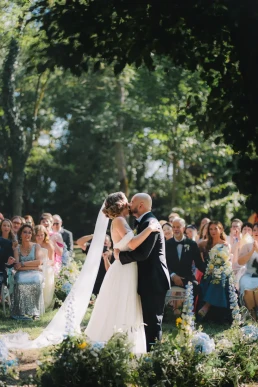
A ceremony has its own timing. The walk down the aisle, the exchange of vows, the rings and the first kiss are not performances for the camera. I will not ask you to repeat them if I want another shot. It is my responsibility to be prepared, choose my position and anticipate what is about to happen.
That preparation sometimes means placing a second camera or arranging a discreet microphone, with the relevant people informed beforehand. Cameras and audio equipment do not disappear completely, and they must never obstruct guests or interfere with the ceremony. In a small space, a good angle may need to be sacrificed so that everyone can see and the moment can unfold properly.
There is also a difference between recording a public ceremony and filming something that you have chosen to keep private. If you want certain vows or conversations to remain off camera, tell me in advance. I can plan the coverage around that boundary rather than expecting you to make the decision while everyone is watching.
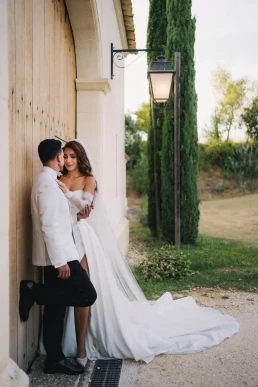
Couple portraits: you can choose to pose, or not
This is the part of the day where some couples actively want my input. I might propose a short walk, a particular location or a simple movement that works well on film. If you enjoy being guided, I can help you feel less self-conscious and suggest a few carefully composed scenes. Posing is available to you, but never required.
For other couples, being alone together for a few minutes matters more than creating a sequence of images. In that case, I can keep my distance, film what naturally happens or leave you in peace. I work with the photographer so that you are not asked to repeat the same actions for two different cameras, or pulled away from your guests twice for essentially the same session. A more deliberate approach can also belong outside the wedding day. For Sam and Zarah in Phuket, we discussed and chose experiences to film before their wedding, including a Muay Thai session and time out exploring the island. Those were agreed parts of their story, not unexpected directions during the celebration. You can see how that film was developed.
Cocktail hour and dinner: filming while you are with your guests
At the cocktail hour, your attention should be on the people you have invited, not on finding the next camera angle. I can move between conversations, expressions, details and the atmosphere of the reception without asking you to leave a group so I can collect another shot. A brief exchange with a guest often tells me more than a posed interaction would.
Dinner and speeches have different requirements. When audio or a fixed camera is needed, I try to arrange those practical details with the planner and the people speaking before the moment begins. That reduces last-minute requests and allows the reception to follow its planned rhythm. If additional lighting is needed, its effect on the room and the guests has to be considered, not just the image it produces.
Being discreet does not mean pretending that no equipment is involved. It means making decisions that respect the celebration. There are moments when I need to be close enough to record what matters, and others when the best choice is to stand further away or simply stop filming.
What if you change your mind at the last minute?
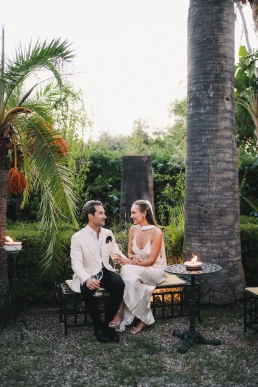
Imagine that we discussed filming a short couple sequence at sunset. On the day, you are having a wonderful time with your guests and have no desire to leave them. You tell me you’d rather skip it. Then we skip it. I may explain that we will have fewer portraits in that light, but there is no pressure to continue simply because the idea appeared in our original plan. The opposite can happen too. You may feel unexpectedly relaxed and ask for a more directed scene that we had never planned. If there is enough time and it does not disrupt something important, we can explore it. I can offer ideas, react to an opportunity or adjust the filming when the schedule changes.
This flexibility does have a practical limit: a scene that was never filmed cannot be recreated in the edit. Some choices will change which images are available for the final film. I prefer to make that clear, then let you decide. A wedding moves quickly, and being able to adapt calmly is part of the job. There should never be a forced shoot.
How to decide how much direction you want
You do not need to choose between a film that feels completely observational and one in which every moment is staged. There is a middle ground, and it can change throughout the day. Some couples want no guidance until their portrait session. Others welcome a few suggestions in the morning but prefer complete freedom once the ceremony begins. Before booking a wedding videographer, ask questions that reveal what filming will actually feel like:
- Which parts of the day do you typically film without speaking to the couple?
- When might you suggest a pose or a scene, and can we decline?
- How do you coordinate the portrait session with our photographer and planner?
- What happens if we cancel a planned shot or need privacy on the day?
The answers should be specific, not simply promises to be “unobtrusive.” For me, a good filming experience is a human one. I can be present, offer help or suggest something creative when you want it, while accepting that the best choice at another moment is to leave you alone. Your wedding stays yours, even when a camera is there. If you would like to hear how that has felt for other couples, you can read their first-hand experiences with Gordon Wedding Films.
Tell me that before the wedding. I can propose a few directed shots only if you both want them, and keep the rest observational. You do not have to share the same level of comfort in front of a camera. We can also decide during the day whether a short portrait sequence still feels right.
No. I prepare my positions and camera coverage for moments that happen once, especially during the ceremony. I will not interrupt the exchange of vows, ask you to repeat your first kiss or try to manufacture a second reaction. Those moments belong to you and your guests, not to the filming schedule.
Yes. Let me know which moments you want to keep private, ideally before the wedding, so I can organise filming accordingly. You can also ask me to stop recording on the day. I can control my own cameras, though I cannot control what other guests may record on their phones.
Sometimes, yes. Certain parts of the day, especially ceremonies and speeches, may require fixed cameras or microphones. A professional setup should be planned to minimise disruption, but it is not literally invisible. If the room is small or the atmosphere especially intimate, we can discuss those constraints before the wedding.
Yes. A request for space should be respected immediately. If you already know that part of the day will be private, tell me beforehand. If you only realise it in the moment, you can simply say so. I can return later or focus on other parts of the celebration.
Not necessarily. The ceremony, guests, preparations and reception can provide meaningful footage without a dedicated portrait session. A separate session can offer more time for carefully composed images, but it remains a creative choice. We can discuss how much, if any, directed footage you would like in your film.