
Planning your wedding in France from abroad
A practical briefing checklist for couples and wedding planners in Provence and the French Riviera
If you are planning a wedding in France from abroad, your videographer needs more than a date, venue and list of suppliers. The most useful preparation is a single, shared briefing document containing your local-time schedule, exact addresses, ceremony format, important people, spoken moments and the person authorised to make decisions on the day.
I am Meryll de Gordon, the destination wedding filmmaker behind Gordon Wedding Films, based in Provence. For weddings in Provence and on the French Riviera, I also ask about the orientation of the ceremony space, access between locations, outdoor sound and the evening light. These details matter whether you are organising everything from London, New York, Singapore or somewhere else. You can prepare nearly all of them remotely, as long as the couple, planner and film team are working from the same information.
Start with one shared brief, not a long email thread
Make one document the reference for everyone, rather than sending changes through separate email and WhatsApp conversations. The wedding planner can own the master schedule, while the couple supplies the personal information that only they know. Label every time as France local time, and identify who will update the document when something changes.
For my own pre-wedding preparation process, I review the schedule with the couple and, when involved, their planner and photographer. A remote call is useful for decisions; a written brief is better for preserving those decisions. Keep the date and version number at the top. The final document should give the filming team enough information to work even if your phone is switched off during the wedding. This is relevant to real celebrations: the client experiences page includes a wedding planned from abroad in Gordes, Provence, and a French Riviera wedding organised by a London-based couple. Both are examples of why clear communication matters without requiring the couple to manage production on the day.
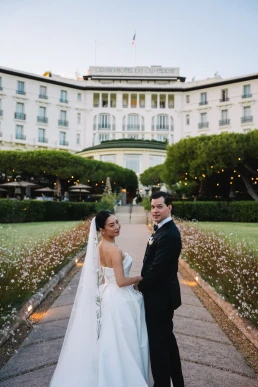
The wedding film of a US couple getting married at Grand-Hôtel du Cap-Ferrat
Show the venue as it will actually be used
A château website or hotel gallery rarely shows exactly where the celebrant will stand, which suite is used for preparations, or how guests move between the ceremony and dinner. Ask the venue or planner for a short phone walkthrough, current photographs and a floor plan with the planned setup marked. Even a simple annotated screenshot can answer questions that polished promotional pictures cannot. For a wedding in Provence, I want to know whether preparations take place in separate buildings, whether the ceremony is under trees or in an open courtyard, and how far the reception area is from the entrance. At a French Riviera wedding, I would also check terraces, steps, service lifts, coastal wind exposure and the route between the hotel and an off-site ceremony.
Be specific. A private estate near Aix-en-Provence might look compact on a map yet have several distant spaces. A hotel such as the Grand-Hôtel du Cap-Ferrat can involve gardens, interiors and separate event areas. These are reasons to confirm access routes with the venue, not assumptions about your chosen setup.
- Send the exact addresses and a marked plan of each space used by the wedding.
- Confirm where the film team can park, unload equipment, access power and store bags.
- Identify any restrictions on tripods, microphones, filming positions or arrival times.
- Share the indoor ceremony and reception options if weather changes.
Plan around light at the actual ceremony location
The sunset time for Nice or Avignon is only a starting point. The useful light depends on your wedding date, the direction the ceremony faces, nearby buildings, trees and hills. A courtyard may fall into shadow long before the official sunset. A sea-facing terrace may stay intensely bright for longer. Ask the planner to mark the ceremony start, expected finish and portrait window on the same schedule. In summer, an exposed afternoon ceremony can mean hard shadows and guests facing direct sun. Moving it slightly later, adjusting the seating orientation or finding shade may be more helpful than adding a long portrait session. In the Luberon, stone walls and sheltered gardens can change the available light within the same venue. On the Riviera, reflections from pale terraces and the sea bring a different set of conditions.
For international calls and final timings, use the wedding date and local French time, not a fixed time difference from home. Mainland France changes between standard and summer time; the official French clock-change calendar confirms the seasonal changes. Agree on the portrait window with both photo and video teams, then make it flexible enough to protect the guest experience.
Explain languages, rituals and the people involved
Do not assume your filmmaker will recognise every meaningful moment by watching it happen. Send the ceremony order, the names of speakers and a short explanation of any religious, cultural or family traditions. For a bilingual or multilingual ceremony, specify who speaks which language, when interpretation takes place, and whether the officiant or reader will use a microphone.
A multicultural wedding does not follow one standard format. The useful question is not where a family comes from, but what this particular couple has chosen to include. For example, a tea ceremony, a family blessing or a reading in Mandarin can have very different timing and filming needs. If a relative is translating the vows, let the filming and sound teams know whether the translation is consecutive or simultaneous.
If your film will include spoken memories as part of a narrative, background about the people and relationships helps. I explain the difference between recording an event and shaping a story in my guide to story-driven wedding films. You do not need to script emotional moments. A simple note saying who will speak and why that person matters is often sufficient.
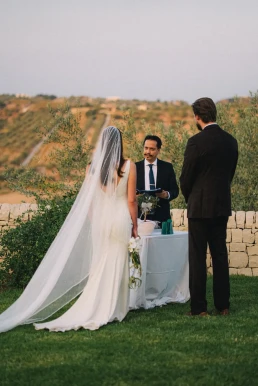
The wedding film of a UK couple getting married in Château Martinay, Provence
Prepare spoken moments for clear sound
For vows and speeches, the number of speakers matters less than where their voices can be recorded cleanly. Confirm whether the ceremony and dinner use a PA system, who operates it, whether a separate audio feed can be arranged and where wind or music might interfere. If speeches happen without amplification, give the filmmaker advance notice so a suitable recording arrangement can be discussed.
Send scripts or notes only if you are comfortable doing so. They help with unfamiliar names and languages, but they are not a requirement. Most importantly, tell the film team about any planned speech, performance or surprise through the planner so the couple does not have to manage it.
Give the planner, photographer and filmmaker clear roles
The planner controls the overall running order; the photographer and filmmaker advise on the practical conditions needed for their work. Neither team should be discovering the other’s plan during the ceremony. Agree in advance who leads any short portrait session, where each operator can stand and who will tell the suppliers if the schedule has slipped.
Ask the planner to send a vendor-facing version of the timeline. It should include access times, ceremony cues, speaker order, transport departures, room transitions, dinner announcements and the correct contact for the sound engineer or DJ. A guest-facing schedule does not provide enough detail for production.
The aim is to avoid small but consequential surprises: a second camera blocked by a floral installation, a microphone unavailable for a speech, or the film team still travelling when guests arrive at the next venue.
Agree on one person for last-minute decisions
Choose one person, usually the lead wedding planner or coordinator, who can confirm a location switch, delayed entrance or revised speech order. That person should be able to reach the filmmaker directly and know which moments cannot simply be repeated. If someone wants to keep a surprise secret from the couple, the coordinator can pass the technical information privately.
Account for travel and events outside the ceremony
A destination wedding can involve a preparation villa, a church, a reception estate and a welcome dinner somewhere else. Put each address into the schedule, along with realistic transfer allowances, guest transport and access details. On the French Riviera, summer traffic can affect short coastal journeys; in Provence, private estates may have long access roads or several entrances.
Tell your filmmaker which events are actually part of the contracted coverage. A welcome dinner and a brunch should not appear as vague notes at the edge of the wedding-day timeline. If you are hosting several events, the destination wedding weekend guide helps with the overall rhythm, while the multi-day wedding videography page explains which moments can be filmed across them. This article is about the operational handover.
For an intimate elopement with only a few guests, the same principle applies on a smaller scale: confirm where you will meet, who carries the rings and letters, and what happens if the planned outdoor location becomes unusable.
Use this wedding videography briefing checklist
You can send the following list to your planner and film team. The couple should complete the personal details; the planner should confirm venues, suppliers and logistics. Keep one current version and mark anything not yet decided instead of leaving it ambiguous.
- Event details: wedding date, each event name, exact address and venue contact.
- Time: complete running order in France local time, with version date and decision-maker.
- Spaces: floor plans or walkthroughs showing preparations, ceremony, portraits, dinner and backup areas.
- Light: ceremony orientation, shaded option, expected end of ceremony and portrait window.
- People: correct names and pronunciation, close family, key friends, speakers and any sensitivities to respect.
- Ceremony: running order, languages, interpretation, rituals, restrictions and officiant contact.
- Audio: microphones, DJ or sound engineer contact, spoken segments and unannounced performances.
- Coordination: planner, photo team, venue and on-the-day lead, with mobile numbers including country codes.
- Access: parking, loading, permitted filming areas, setup time and travel between addresses.
- Coverage: which welcome, wedding-day, brunch or other activities are included, with start and finish times.
- Weather and changes: indoor alternative and who communicates a revised plan.
- Final confirmation: circulate the updated master brief to all relevant suppliers before the event.
My role is to turn this information into a practical filming plan, not give the couple another production job. When the details are shared early, you can arrive in France knowing your filmmaker understands the people, places and moments that matter to you.
No. I work in English and French, so planning conversations can take place in English. The important point is to identify where another language will be spoken during the ceremony or speeches, and who can explain the meaning of any tradition or unfamiliar terms. This also helps with names, captions and possible translations during editing.
Most of the video briefing can be handled remotely using a call, venue floor plans, a short live walkthrough and the planner’s photographs. What cannot be fully confirmed from overseas is the exact lighting and sound on the wedding date. The local team should therefore check access, the ceremony setup and backup locations before the event.
A legal marriage and a symbolic ceremony are different arrangements. French civil marriage requires formalities with the relevant town hall, and eligibility depends on your circumstances, including residence or other legal connections. Verify the requirements directly with the town hall and the official French administration. For the film, share which ceremony is taking place, where and whether recording is permitted.
Ask the planner to tell the filmmaker privately. The team needs to know the approximate time, location, number of speakers and microphone setup, but the couple does not need to know the surprise itself. Without that information, an important moment could begin before the cameras and sound recorders are ready.
Yes. Name the indoor alternative, show how the ceremony furniture and guests will be arranged, and identify who decides when the plan changes. An indoor ceremony can require a different camera position, sound setup and lighting approach. The videographer should receive the decision at the same time as the planner, photographer and officiant.
You can ask, but an aerial film cannot be guaranteed. Flight permission depends on the location, airspace restrictions, conditions, pilot qualifications and the proposed operation. In the EU open category, flights over assemblies of people are prohibited. Have the operator verify feasibility with the venue and applicable aviation rules before adding drone shots to the plan.