
Working with GordonWeddingFilms
A wedding film experience shaped with intention
Working with GordonWeddingFilms is not simply about booking someone to film your wedding day. It is about choosing a filmmaker with a structured, story-driven approach to emotionally rich celebrations, refined aesthetics, and complex destination and multi-day celebrations across Europe and Asia. From the first conversation to the final delivery, each step is designed to bring clarity, comfort, and creative direction. The result is not just a record of the day, but a wedding film built with purpose, crafted to feel personal, timeless, and deeply true to what was lived.
- Multi-awarded recognition: Consistently recognized for quality and storytelling, including multiple awards as Best Wedding Videographer in France
- Destination and multi-day weddings: Extensive experience across Europe, Asia, and international locations, with the ability to handle complex, multi-day celebrations
- Narrative and timeless storytelling: A structured approach built around emotion, rhythm, and meaning, designed to create films that remain relevant over time
- International clientele: Fluent in English and French, with experience working with couples from the US, UK, and worldwide
- Trusted planner collaboration: Regularly working alongside experienced planners and coordinated vendor teams in high-end wedding environments
- Structured process and delivery: From pre-wedding planning to final edit, each step is designed to ensure clarity, consistency, and a refined final result
- Over a decade of experience: Filming weddings since 2014, with a consistent focus on cinematic storytelling and real moments
- Two distinct film approaches: A refined, documentary-style coverage or a more immersive narrative experience built around your story
Before the wedding
Preparation, guidance, and clarity
The quality of a wedding film is largely determined before the wedding even begins. A well-prepared day creates better conditions for natural moments, smoother logistics, and a more coherent film. Before the wedding, I stay involved through a structured and accessible process. Most couples schedule 1 to 3 calls, depending on the complexity of the event, to refine expectations, discuss the flow of the day, coordinate with wedding planners, and address any concerns. Pre-production improves both comfort and final film quality. These exchanges often go beyond video. I regularly help couples improve their timeline, adjust key moments based on light conditions, and anticipate transitions between locations. For the wedding of Sam & Zarah in Phuket, we planned three video calls and stayed connected via WhatsApp throughout the entire process.
Destination weddings or multi-day events
For destination weddings or multi-day events, preparation becomes even more important. I coordinate directly with the wedding planner and sometimes with the photographer to align on timing, identify key sequences, and avoid unnecessary constraints on the day itself. This can include reviewing ceremony timing for optimal light, understanding venue limitations, or planning the flow between preparation, ceremony, and reception.
I’m your guide
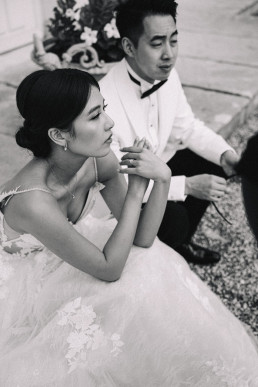
I also guide couples on aspects they don’t always expect. I can recommend pre-wedding activities such as a welcome dinner or a relaxed couple session, like for the wedding of Nicole & Jack in Thailand for which we planned excursions together with their friends before the wedding. These moments often help build a more complete and personal film, while easing pressure and allowing for more natural footage.
Beyond logistics, this phase is about comfort. Many couples are not used to being filmed, and I take time to explain how I work, what to expect, and how little they actually need to “perform.” This preparation has a direct impact on how natural and relaxed the footage will feel. For Pipay and Reda’s wedding in Marrakech, we worked closely with the photographer and suggested to the wedding planner that the ceremony be held in a different location, one that was far more photogenic. She trusted our vision. The result was striking, with beautiful imagery, and the couple was more than satisfied.
Recognised and trusted
- Featured interview: this process was also featured in an interview with Wezoree in an article called “Crafting Meaning Through Motion – Inside Meryll de Gordon’s Vision of Wedding Cinema“, offering a deeper look into how each film is prepared and crafted.
- Podcast guest: in a recent podcast conversation, I go deeper into this approach, explaining how storytelling, trust, and preparation all come together to create films that feel personal and true.
- Best Videographer recognition: following my recognition as Best Videographer 2021, I was invited to share my approach and process in this video interview.
- Awards by named organisations: recognized with awards from InspirationPhotographers and WEVA.
During the wedding
Discretion, anticipation, and control
On the wedding day, my role is to be present without being visible. You are not expected to pose or perform. This approach is designed for couples who prefer a natural, unobtrusive experience, even if they feel shy in front of the camera. I do not over-direct. Instead, I create a calm environment where moments can unfold naturally, with subtle guidance only when needed. The intention is to capture what is real, not to stage it.
A typical wedding day involves continuous filming over 10 to 12 hours, often across multiple locations and lighting conditions. Throughout the day, I adapt to the rhythm of events, following the planner’s timeline while remaining flexible when things shift, which happens frequently. Protecting the flow of the day is essential. Filming is always designed to integrate seamlessly into the experience, without slowing anything down or drawing attention.
Rather than directing moments, I focus on positioning and timing. Key sequences such as the ceremony, speeches, or couple moments require precision, not intervention.
I also work in close coordination with the photographer and wedding planner, especially during critical moments, to ensure everything runs smoothly without interference. Even with complex timelines or multi-day celebrations, everything is anticipated in advance, so the day remains fluid, structured, and effortless from your perspective.
Two approaches, one philosophy
Editorial or Story-driven
Each couple approaches their wedding differently, and the film should reflect that. To reflect this, I offer two distinct approaches:
- The narrative approach is built around real audio. Vows, speeches, and natural exchanges become the backbone of the film. The editing is structured to create an emotional progression, almost like a short documentary. This approach works particularly well for multi-day weddings, destination events, or couples who want a deeper, more personal film. Narrative films are deeper and audio-led.
- The Editorial / Classic approach is more visual and restrained. It focuses on atmosphere, composition, and elegance. The film is driven by rhythm and imagery rather than a structured narrative. It is often chosen by couples who prefer something more subtle and refined.
In both cases, the goal remains the same: creating a film that feels coherent, intentional, and meaningful over time.
The narrative approach is designed for couples who want to tell a deeper story across multiple moments, while the classic approach suits those who prefer a refined and natural documentation of the wedding day itself. I’ve had the opportunity to share more in-depth thoughts on this approach in a podcast conversation, where I discuss storytelling, connection, and the way each film is built from the ground up.
After the wedding
From footage to film
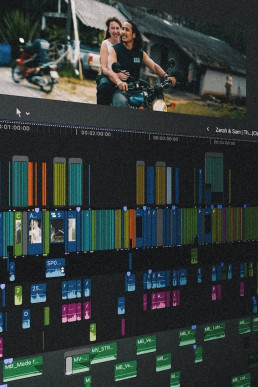
Once the wedding is over, the largest part of the work begins. A wedding typically generates several hours of footage, but only a small percentage is used in the final film. The selection process is meticulous and can take several days on its own.
- The editing phase is where meaning is created, it usually represents 30 to 60 hours of work, sometimes more for complex or multi-day weddings. It includes reviewing all footage, identifying meaningful moments, and building a structure that makes sense both visually and emotionally.
- Sound plays a crucial role. I work with multiple audio sources captured during the wedding to integrate vows, speeches, and ambient sound. This creates a more immersive and authentic experience. Music is then carefully selected to support the rhythm and tone of the film.
- Narrative structure. Each film is structured through a deliberate narrative arc, where sound plays a central role. Vows, speeches, and natural audio are carefully designed to bring depth, continuity, and emotional resonance.
- Color grading is adapted to the environment. Light in Provence, the French Riviera, or Thailand behaves differently, and the final image must reflect that atmosphere while remaining consistent.
What you receive
Most couples receive a combination of formats designed not only to cover the day, but to create films with strong rewatch value, emotional density, and a clear narrative structure.
- This typically includes a short film of around 3 to 5 minutes, crafted to deliver a focused and powerful experience, where every moment is intentional and carries meaning,
- and a longer film of around 15 minutes, offering a more immersive and structured retelling, without becoming exhaustive.
- Rather than adding more footage, the objective is to create stronger films. A shorter format often allows for greater emotional impact, as it concentrates the most meaningful moments into a cohesive and engaging narrative.
- Sound design, including vows, speeches, and ambient layers, plays a central role in shaping the film’s depth and emotional resonance.
- Each edit is built with a deliberate rhythm and progression, allowing the film to be experienced as a story, not simply watched as a sequence of events.
- Additional options can be integrated depending on the project, such as a multi-camera ceremony film, reception speeches, or a Super 8 sequence for a more organic visual texture.
Each project remains flexible and is adapted to the structure of the wedding and the level of storytelling envisioned.
Weddings are live events. There is no second take. Every moment happens once, which makes technical reliability essential at every stage.
- Multiple audio sources are used during key moments (ceremony, vows, speeches) to ensure clarity and consistency,
- Simultaneous recording across different cameras and devices provides layered security throughout the day,
- Backup equipment is always available and ready to be deployed instantly if needed,
- Secure data handling with immediate backups and redundant storage minimizes any risk of loss,
- Adaptation to changing light allows for consistent image quality, from harsh sunlight to low-light environments.
This structured approach ensures that even within complex timelines or unpredictable conditions, every part of the day is captured reliably, without compromise.
Technical approach
Reliability and consistency
Working with a team
Flexibility without compromise
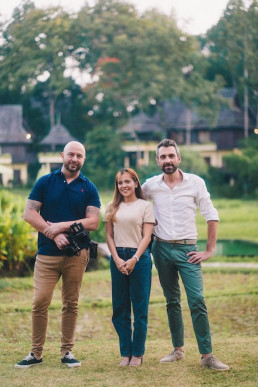
The team setup is adapted to the scale and complexity of each wedding. Smaller weddings are often filmed alone, while larger celebrations, multi-day events, or complex logistics may require a second shooter to ensure full and seamless coverage.
- Second shooter when needed to cover multiple locations, parallel moments, or extended timelines without compromise,
- Broader and more fluid coverage, allowing key moments to be captured simultaneously from different perspectives,
- French-based team: Meryll (videographer & editor), Joris (videographer), Jonathan (videographer & drone operator),
- Southeast Asia team: Matteo (videographer), PloyDao (videographer & drone operator), with Meryll involved depending on the project,
- Consistent creative direction, with all footage edited and supervised by Meryll to ensure a cohesive result.
Even when working with a team, the creative vision remains centralized. This ensures consistency in storytelling, aesthetics, and overall film quality across every project.

Destination weddings
Experience across environments
Destination weddings involve a higher level of complexity than local events. Travel logistics, cultural differences, multi-day timelines, and coordination with international teams all require a structured and adaptable approach.
Having filmed weddings across Europe, the United States, Costa Rica, Morocco, Italy, Mallorca, Santorini, Sicily, and Thailand, I am used to adapting quickly to different environments, teams, and cultural contexts, while maintaining consistency across the entire experience.
For couples planning a destination wedding videographer, this experience provides a reliable framework. Both the creative and logistical aspects are handled with precision, even in complex or multi-day setups.
This approach is designed to manage complexity without adding friction to the day. It includes:
- Multi-camera coverage during key moments (ceremony, speeches), ensuring simultaneous perspectives without missing anything,
- Dual audio systems with primary and backup recordings to secure vows and speeches in all conditions,
- Redundant data management with immediate backups and multiple storage layers,
- Backup equipment on-site (cameras, lenses, audio) ready to be deployed instantly if needed,
- Travel buffer days when required, allowing adaptation to delays, weather, or last-minute changes,
- Pre-event coordination with planners and vendors to align on timeline, constraints, and key sequences.
This structure allows the wedding to unfold naturally, while ensuring that every important moment is captured with reliability and precision.
For complex destination weddings, this provides a safe and experienced framework you can rely on from start to finish.
Collaboration with vendors
Collaboration with vendors
A wedding is a coordinated effort. The quality of the final film depends on how well each vendor works together within a structured and often demanding environment.
I regularly collaborate with planners such as The Wedding Bliss Thailand, Cigales et petits fours, Jour de rêve, as well as photographers, venue teams, and international production crews. These collaborations often take place within luxury weddings involving complex logistics and highly coordinated vendor teams, such as the wedding of Val & Lyle at the Four Seasons in Chiang Mai or the wedding of Nat & Jum in Bangkok and Hua Hin.
This level of coordination directly benefits the experience:
- Smoother timelines, with every moment anticipated and aligned across teams,
- Fewer constraints during the day, allowing events to unfold naturally,
- Better timing for key moments such as ceremonies, entrances, and couple sessions,
- Aligned priorities between planner, photographer, and videographer, ensuring consistency in execution.
Before the wedding, I coordinate closely with planners and key vendors to align on timeline, constraints, and expectations. During the event, communication remains discreet but continuous, ensuring that everything runs fluidly without disrupting the experience.
This approach is designed to operate efficiently within high-end, tightly coordinated weddings, where precision, timing, and collaboration are essential.
Why couples choose GordonWeddingFilms
Beyond the film
Couples who choose Gordon Wedding Films are looking for more than coverage. The focus is on creating films with emotional depth, clarity, and lasting meaning. For a deeper insight into the work, you may browse the latest press features, explore genuine client experiences, and understand the recognition behind being awarded Best Wedding Videographer in France
This approach is designed for couples who value emotional depth over volume.
- A structured narrative, where vows, speeches, and real interactions shape a film that feels intentional and cohesive,
- Experience with complex, multi-day weddings, ensuring smooth execution across locations, timelines, and teams,
- A discreet yet controlled presence, allowing natural moments to unfold while maintaining strong visual composition,
- A timeless editing approach, avoiding trend-driven edits and exhaustive documentary coverage,
- Direct creative involvement, ensuring consistency in storytelling, pacing, and overall film quality.
The objective is not to deliver more footage, but to create films that remain meaningful and engaging over time.
“Throughout the celebrations, he was so respectful and pleasant that it genuinely felt like he was part of the wedding party.” – Isaiah & Tanya (wedding at Hyères, France)
“He was incredibly attentive and supportive in the months leading up to our wedding, making the entire experience feel relaxed and seamless.” – Céline & Daniel (wedding at Domaines de Patras, France)
Who this is for
- This is for you if…
- You are drawn to a story-driven approach, where your film is built around meaning, not just moments,
- You prefer a natural and non-posing experience, without constant direction or staging,
- You value emotion, intention, and structure over volume or quantity of footage,
- You want a film that feels personal, immersive, and crafted, not just documented,
- You are planning a wedding where experience and flow matter as much as the final result.
This may not be the right fit if…
- You are looking for exhaustive, start-to-finish coverage of everything that happens,
- You prefer trend-driven edits or fast-paced, effect-heavy styles,
- You expect raw footage to be the main deliverable,
- You want a highly directed experience with frequent posing and staging,
- Your priority is to capture everything rather than shape a story.
The goal is to ensure a strong alignment from the beginning, so the experience and the final film reflect exactly what matters to you.
A clear fit from the start
Designed for couples who value story, emotion, and intention over volume or trends
For destination weddings and multi-day celebrations, with a story-driven or refined approach.
Frequently asked questions
Many couples worry about feeling awkward in front of the camera. In reality, most wedding films are built around natural interactions rather than staged moments. A good videographer does not expect performance but observes real behavior.
What helps most is understanding that you will not be asked to act. The preparation phase is used to build trust and remove pressure. Small adjustments in your schedule, such as allowing time to breathe between moments, also make a significant difference.
In my work, I guide couples before the wedding so they know exactly what to expect. On the day, I keep direction minimal and focus on creating a calm environment where you can simply be yourselves.
Weddings rarely go exactly as planned. Delays, weather changes, or last-minute adjustments are common, especially in destination weddings. An experienced videographer anticipates these situations and adapts without disrupting the day. This includes adjusting filming positions, rethinking sequences, and prioritizing key moments.
Personally, I always work with flexibility in mind. I stay aligned with the planner and adapt in real time, ensuring that even unexpected changes can still lead to strong and meaningful footage.
This is one of the most common concerns. Most couples do not want to feel directed but still need some guidance.
The balance usually consists of giving light direction when needed, such as positioning or movement, while allowing moments to unfold naturally. The goal is to avoid anything that feels forced.
In my approach, I guide subtly when necessary, but I never stage emotions. This allows the film to feel authentic while still benefiting from a controlled visual composition.
A wedding day generates hours of footage, but only a small percentage is used in the final edit. The selection process is based on emotional value, narrative coherence, and visual quality.
Moments are not chosen only because they are important, but because they contribute to the rhythm and structure of the film. This is what creates a coherent experience rather than a simple chronological recap.
I personally review all footage and build the film with intention, ensuring that every sequence has a purpose and contributes to the overall story or atmosphere.
Most couples prefer to trust the videographer’s creative direction, but some level of input can be helpful, especially regarding preferences and sensitivities.
For narrative wedding films, many couples naturally become more involved in the process. They start to engage with the storytelling and sometimes suggest ideas, moments, or experiences they would like to include or explore on film.
In general, this involvement happens before the wedding rather than during editing. Sharing what matters to you, what you value, and what you want to avoid helps shape a film that feels personal and intentional.
I take time upfront to understand your expectations and guide you when needed, so that everything remains clear and aligned. This allows the editing process to stay consistent, without constant back-and-forth, while still reflecting your story in a meaningful way.
Weddings are emotional events, and not everything can be controlled. Guests may behave spontaneously, and sometimes unexpectedly.
A professional videographer anticipates this and frames situations carefully to preserve the tone of the film. The editing process also plays a key role in maintaining balance and avoiding uncomfortable sequences.
In my work, I remain attentive to these dynamics and ensure that the final film reflects the best version of the day while staying truthful.
Ceremonies, speeches, and private exchanges can be highly emotional. Capturing these moments requires both technical precision and sensitivity.
The use of multiple audio sources, careful positioning, and anticipation allows these moments to be captured without interruption. Discretion is essential to avoid breaking the intimacy of the scene.
I approach these moments with a strong focus on respect and presence, ensuring they are captured authentically without intrusion.
Whether you’re getting married in Japan, Mexico, South Africa, Bali or Vietnam, destination weddings often involve different traditions, languages, and expectations. Understanding these differences is essential to capturing the day accurately.
This includes adapting to ceremony structures, respecting cultural practices, and working with international teams.
Having worked across multiple countries, I am used to these variations and take time to understand each context so the film reflects the wedding as it truly happened.
Multi-day weddings can include welcome events, ceremonies, and brunches, often with different atmospheres and locations.
Maintaining consistency requires a clear vision and careful editing. Each part must feel connected, even if the environments change.
I approach multi-day weddings as a single story, ensuring continuity in tone, rhythm, and visual identity across all moments.
Trends in editing and music change quickly, but a wedding film should remain meaningful over time.
Timeless films are usually built on real moments, natural sound, and a balanced editing style rather than fast-paced effects or trends. I focus on creating films that feel personal and grounded, so they can still be watched and appreciated years later without feeling dated.
Each collection is built around a clear structure, while remaining flexible to adapt to your wedding.
- The Classic collection focuses on the wedding day itself. It typically includes up to 10–12 hours of coverage, from preparations to the main moments of the evening. You receive two films: a short cinematic highlight (around 3–5 minutes) and a longer film (up to 15 minutes), capturing the key moments and overall atmosphere of the day.
- The Narrative collection expands on this by integrating a storytelling approach. Coverage can include the wedding day as well as additional filming time (such as a pre-wedding session or moments captured the day before). You receive a short narrative film (4–6 minutes) and a longer documentary-style film (up to 15 minutes), built around your story and personal elements.
Both collections can be extended depending on your wedding structure. Options include additional hours of coverage, a second videographer for multi-location or larger weddings, drone footage (subject to conditions and regulations), and extended edits such as full ceremony or speeches. The goal is to offer a clear framework, while allowing enough flexibility to match the reality of your wedding.
Real weddings. Real moments. Truly timeless.
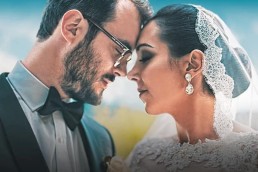
A vineyard wedding in Burgundy
Welcome to the wedding of Rose and Boris, a beautiful Canadian couple who got married with class and sophistication! A…
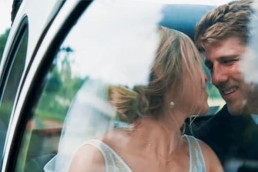
Wedding in Charente, France
This is the story of a 12 year old girl who writes in her diary the name of the man she will later marry. Years have…
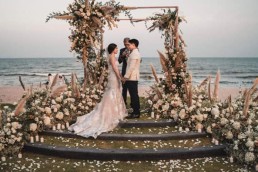
Destination wedding in Bangkok, Thailand
Nat & Jum live in Bangkok, and I couldn’t imagine not shooting them in their daily lives. They invited me to a homemade…
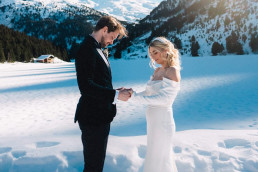
A wedding in Meribel, French Alps
Nestled in the heart of the French Alps, Lucy and Henrik’s wedding was a breathtaking blend of elegance, intimacy, and…