
What happens to your wedding footage after delivery?
Raw files, six-month retention and options for future edits
What happens to your wedding footage after delivery? The finished films and the original camera recordings follow different paths. At Gordon Wedding Films, I keep the original footage for six months; it is not stored indefinitely. During that time, you can ask about a new edit, adjustments to an existing film or access to unedited material, with additional work considered on a separate quote.
The files are backed up as part of the production process, but that does not make my archive a permanent backup service for couples. Once your films arrive, download them and keep your own copies. If you might want something else from the recordings, ask early. The specific date on which your six-month period ends should be confirmed for your project.
What happens to the original footage after the wedding?
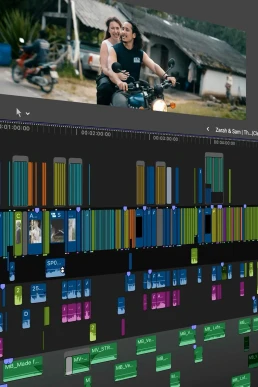
The wedding ends, but the camera files still have a lot of work to do. They are transferred into the editing workflow, organised and backed up before I begin selecting images and sound. The original clips are the material from which the finished film is created. They are not the same thing as the video you eventually watch. A ten-hour wedding does not mean ten hours of continuous video. A camera may be stopped between moments, several cameras may record the same scene, and important audio may be captured separately. That is why a folder of raw footage is often more complicated to navigate than couples expect.
I handle the editing of Gordon Wedding Films projects myself, including the selection, sound and final structure. You can find more about the process on the wedding film experience page. This article addresses a different question: what happens to the files once that work is complete.
What is delivered, and what remains in the archive?
Your delivered film and the original recordings are different files. The delivered film is an edited, finished video with its selected images, sound and colour work. The original footage consists of the camera recordings used to make it, including takes that never appeared in the finished version.
RAW footage is not automatically included simply because a wedding was filmed. If it forms part of your collection, or you decide to add it as an option, the contents and delivery method should be agreed separately. A complete ceremony edit or a speeches film is also different from a folder of unedited camera clips. You can read about these optional deliverables in my guide to wedding videography collections and costs.
Do not assume that a viewing link is a permanent archive. Download the files you have been given and check that they open properly. The availability of the link, the original footage and any editing project files can be subject to different arrangements.
The highlight film is 3 to 4 minutes long, while the complete RAW footage amounts to approximately 2 hours and 30 minutes.
How long does Gordon Wedding Films keep raw footage?
I keep the original wedding footage for 6 months. This is a limited retention period, not an indefinite storage service. If you are considering another film, a revised edit or the purchase of raw footage, I recommend contacting me as early as possible rather than waiting until the end of that period.
The exact start date of the six months should be confirmed for your wedding in writing. Once the applicable period has ended, the files may be removed from the working archive, and I cannot promise that they will still be available for retrieval.
Here is the file lifecycle in simple terms:
Camera clips and separate audio recordings are created.
↓
Working copies help protect the production while the film is assembled.
↓
You download the agreed edits and make your own backups.
↓
Additional changes or a new edit can be requested on quotation. Confirm your own project’s retention deadline.
↓
Original files may be removed; subsequent recovery is not guaranteed.
How are the recordings protected while the film is being made?
A backup is a second copy kept so that a technical problem with one device does not automatically mean the loss of the source material. During production, I work with immediate backups and redundant storage, as described in my filming and editing process. For example, a corrupted working drive should not be treated as the only place where a wedding exists.
Backups during editing and long-term archiving have different purposes. The first protects an active production. The second would mean a commitment to preserve and recover material for a defined number of years. My six-month policy concerns the retention of original footage; it should not be understood as a promise to provide a permanent cloud archive or an unlimited restoration service.
No storage method is entirely risk-free. The practical questions to ask any wedding videographer are where copies are held, when the material is first backed up, how long the originals are retained and what happens when the agreed period finishes. I do not publish the exact number, locations or technical specifications of my storage devices, so I will not invent those details here.
Can you request a new edit or changes after delivery?
Sure! You can ask me to change an existing film or create another edit, and I can prepare a separate quote. This might mean a different version for family viewing, an additional sequence focused on speeches, or a revised selection of moments. What is possible depends on the material recorded and whether the required source files are still available.
For example, imagine that you realise several months later that you would like a longer version of a family speech. If the relevant audio and camera recordings were captured and are still retained, I can examine the request and explain what can be made from them. An unrecorded moment cannot be reconstructed, and material that exists does not always provide continuous coverage.
To make a request useful, tell me which film you are referring to, the moment or person you would like included, and the result you have in mind. I can then assess the footage before proposing a price. Any corrections or revisions already covered by your agreement remain subject to those agreed terms; this paragraph concerns additional work.
Can original footage be recovered after six months?
It may not be possible. When the six-month retention period has ended, original footage may already have been deleted from the working archive. An old film being available to watch does not mean that every original camera file still exists. The same is true of a previous social-media clip or a screenshot taken from a film.
If you contact me after the period, I can only check what is actually still available. There is no guaranteed recovery procedure for material that has already been removed. This is one reason to request raw files or additional edits while they remain within the retention window.
Some couples decide that the finished film is all they need. Others place value on the unused recordings, even though those files are not polished or arranged for easy viewing. Neither choice is automatically better. The important part is deciding while a choice is still possible.
How should you back up your wedding film for the future?
Once your film is delivered, save a copy yourself. A private link is convenient for watching and sharing, but it should not be the only place your wedding film exists. The same goes for a single laptop or a single USB drive.
A simple routine is enough for most couples:
- Download your full-quality finished films and check the files open.
- Keep a local copy on a computer or home storage device.
- Make another copy on an external drive.
- Keep an additional copy in a separate secure location or cloud service.
- Recheck your files occasionally and when changing devices.
Give the files clear names, such as Wedding_Film_Final and Wedding_Ceremony, rather than relying on download dates. If you share your film with relatives, keep your own master file instead of saving a compressed social-media version. The version that you download and protect is the one you control.
You can ask me to check whether that person appears in the original recordings. Being present at the wedding does not guarantee that every guest was filmed, or that a usable shot exists. If the footage is still available, I can explain the options for a separate edit or file delivery and provide a quote.
No. Raw footage is generally a collection of camera clips, sometimes recorded from different angles, rather than a single uninterrupted film. There may be pauses between shots, repeated takes and material that has not been colour-graded or edited. If you need a continuous ceremony or speech film, discuss that as a separate deliverable.
Not necessarily. Original footage can look flatter, have uneven sound levels or include camera starts, stops and ambient noise. The finished film benefits from selection, colour grading, audio mixing and editing. Receiving raw footage gives you access to the recorded material, not another finished version of the film.
Yes. A request for a modified film is different from purchasing the entire folder of source material. Explain what you would like changed, and I can review its feasibility and provide a quote for additional editing. The terms of any adjustments already included in your original agreement continue to apply.
Do not assume that it does. If a new edit has been agreed, ask me to confirm in writing which files will be needed and how long they will remain available. This avoids confusion between the delivery date of an additional film and the retention period for the original wedding recordings.
Contact me with your names, wedding date and the film you are missing. I can check whether a copy is still available, but I cannot guarantee recovery or permanent access to an old delivery link. Keeping several copies of your finished film on different storage services is the safest way to avoid depending on a later restoration.