Switzerland Elopement Guide
A practical guide for international couples planning an elopement in Switzerland
By Meryll de Gordon, destination wedding filmmaker
A Switzerland elopement built around one region
The landscape should feel part of your story, not just a backdrop.
Switzerland can make an elopement feel both adventurous and remarkably considered. The mountains are the obvious draw, but the real strength of the country is how a train journey, a quiet village, a lake, a meal and a ceremony can belong to the same experience. I am Meryll, the destination wedding filmmaker behind Gordon Wedding Films. I have filmed weddings in Switzerland from 2022 to 2026. That experience makes me pay close attention to more than the view: how people move through a place, where the day can slow down, how voices will sound and whether the plan still works when the weather changes.
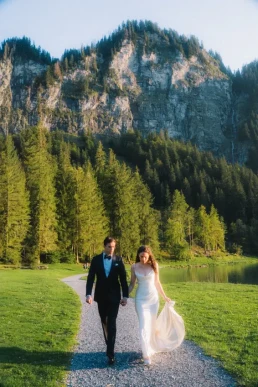
An elopement is an intentionally small wedding centred on the couple and the way they want to experience their commitment. It can be only the two of you, or include a few close people. It can be legally binding or symbolic. What defines it is not secrecy or a dramatic mountaintop. It is the freedom to build a day around your relationship, your pace and the people or activities that matter to you. More than anything, it is about the experience itself: being alone together, far from everyday expectations, creates space to focus on each other, feel things more deeply and live the moment without having to perform for anyone else or answer to a larger group.
What choose ta have an elopement in Switzerland?
Why choose Switzerland?
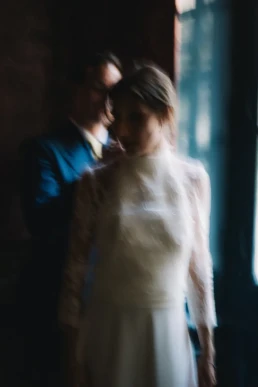
Switzerland offers unusual variety without requiring a complicated domestic flight plan. You can arrive by international rail or air, stay in a car-free village, take a mountain railway for your ceremony and return for dinner without turning the day into an expedition. The combination of alpine peaks, lakes, valleys and mountain villages also creates exceptional images and gives the film a strong sense of scale. Its organization helps, but mountain weather, lift maintenance, protected areas and site-specific commercial rules still shape the plan.
Choose the experience before the viewpoint
There is no single best place to elope in Switzerland. Begin with four decisions: the atmosphere you want, the amount of walking you enjoy, whether the ceremony will be legal or symbolic, and how much uncertainty you are comfortable holding. Then choose one base, one primary outdoor plan and one backup you would still be happy to experience. The mountain can be extraordinary without becoming the whole story.
The best regions for a Switzerland elopement
From alpine villages to lakeside escapes, choose the landscape that fits your experience.
Bernese Oberland
Lauterbrunnen, Wengen, Mürren and Grindelwald combine waterfalls, alpine villages, mountain railways and dramatic peaks within a relatively compact area. It works especially well for couples who want to mix an intimate ceremony with scenic train journeys, short hikes and a mountain dinner. Popular viewpoints can become busy, so privacy needs to be planned around timing and location rather than assumed.
Zermatt
Zermatt offers a very strong visual identity around the Matterhorn, with a car-free village, mountain railways and high-altitude viewpoints. It is particularly suited to a two or three-day elopement with time for the ceremony, a mountain experience and a quieter second location away from the busiest viewpoints.
Engadin
The Engadin offers a different side of Switzerland, with broad lakes, larch forests, open valleys and high mountain landscapes around St. Moritz and the surrounding villages. It suits couples looking for more space and a slower atmosphere, with possibilities for hiking, lakeside moments and scenic rail journeys. Mountain lifts and seasonal routes should always be checked for the exact dates of the trip.
Lake Lucerne
Lake Lucerne is a strong choice for couples who want mountains without building the entire experience around hiking. Boats, historic hotels, mountain railways and lakeside towns can all be combined easily, while lower-altitude locations provide useful alternatives if the weather changes.
Appenzell
Appenzell combines pastoral hills, traditional villages, limestone mountains and remote mountain inns. It can create a very intimate atmosphere, especially for couples who enjoy walking and want the landscape to feel less monumental and more personal. Routes should match your real hiking ability, particularly when accessing higher areas such as the Alpstein.
Lavaux and Ticino
Lavaux and Ticino offer a softer, warmer alternative to the high Alps. Vineyards above Lake Geneva, Mediterranean-style villages, gardens and lakeside settings can work beautifully for couples who want a slower experience with less mountain travel. Vineyards and gardens are often working or private properties, so professional filming and ceremony access should be confirmed in advance.
Oeschinensee
Oeschinensee is visually spectacular, but it should not be presented as a professional elopement location. Its official local rules prohibit commercial events, including weddings, as well as all drone flights. It can still inspire the type of alpine scenery you may want, but another location should be chosen for the ceremony and professional filming.
When is the best time to elope in Switzerland?
Access matters as much as weather
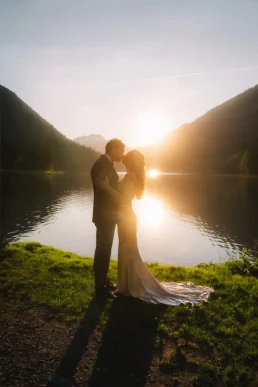
June through September provides the broadest access to trails, huts and mountain transport. June has long days and seasonal reopenings. July and August offer the widest access with peak crowds and afternoon-storm risk. September can feel calmer, although services reduce later in the month.
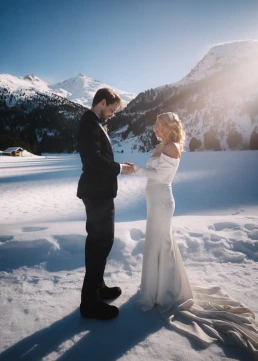
Spring and late autumn are transition periods. Lakeside places may be beautiful while high paths remain snowy or lifts are closed. Winter needs its own plan around open resorts, safe marked routes, short daylight and warm interiors. Check the exact elevation, operator and year.
How many days do you need?
Give yourselves time to experience Switzerland, not just get married.
A one-day elopement can work, but Switzerland becomes much more interesting when the experience extends over two or three days. The first day might begin with your arrival, a scenic train journey, dinner in a mountain village, a walk by the lake or reading letters together somewhere quiet. The wedding day can then focus entirely on the preparations, ceremony and celebration, without trying to fit every experience into a few hours.
A third day creates even more freedom: take a mountain railway at sunrise, hike to a quieter landscape, cross a lake by boat, have lunch in a mountain refuge, spend an afternoon at a spa or explore another valley together. It also gives you flexibility if the weather changes.
The benefit is not simply more time in front of the camera. It is the feeling of having travelled somewhere together and truly experienced it. Those different moments, landscapes and rhythms also give the final film a much richer story, with an arrival, a wedding and the memories surrounding it.
How I help plan an elopement as a filmmaker
Planning for light, sound and a real pace
My role begins before I arrive with a camera. I look at the order of the day, real travel time, light, sound, the people who matter and what could happen if a lift or outdoor location becomes unavailable. I can help you decide which periods are worth filming, how an activity can feel natural rather than staged, and where a quiet conversation, letter or vow could give the film its emotional structure. I coordinate with your planner, photographer and venue so the filmmaking fits the experience instead of interrupting it. Read more about my approach to the full wedding-film experience.
A realistic 3-day Switzerland elopement
Day one: arrive and slow down
Settle into your hotel or chalet and start enjoying the destination without any pressure. Take a scenic train, walk through the village, stop for coffee by the lake, spend time at the spa or share a relaxed dinner together.
Day two: the wedding
Keep the day focused on the ceremony and the experience around it. Get ready slowly, travel to one beautiful location for the vows, spend time in the landscape afterwards, then return for champagne, dinner or an intimate celebration.
Day three: continue the experience
Use the final day for something different. Take a mountain railway, hike to a quieter viewpoint, cross a lake by boat, have lunch in a mountain refuge or explore another village. It gives the trip a real sense of journey and adds much more variety to the final film.
Activities that add something to the story
Choose what you genuinely want to live
Choose an activity because you want to live it, not because it fills a shot list. A scenic train gives the film anticipation and the sound of arrival. A boat creates a natural pause. A walk or hike gives you time to talk and reach a place together, provided the route matches your real ability. Skiing, snowshoeing, a vineyard walk, a mountain-inn meal, letters or a family voice note can all add regional or personal meaning. For a longer celebration, the same principle shapes a multi-day wedding film: each period should add a relationship, a place or a change in emotion.
The images and sounds that make it meaningful
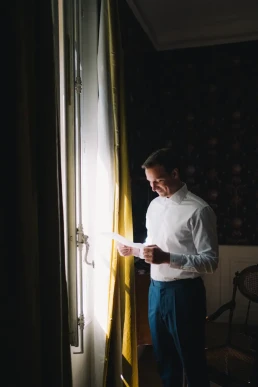
The wide mountain frame matters, but it rarely tells me who you are. A strong film moves between scales: a train crossing a valley, the way you wait for each other on a path, the sound before your vows, hands around a warm drink, a parent calling from another time zone and the meal at the end of the day.
Wind, waterfalls, cowbells, stations and visitors give a real sense of place, but vows need a sheltered and quieter position. My documentary storytelling approach brings voices, natural sound, images and relationships into one film.
Legal or symbolic ceremony?
Civil marriage. A Swiss civil marriage requires a preparatory procedure. If neither partner lives in Switzerland, the chosen civil-status office handles the application and foreign non-residents require authorization through the competent cantonal authority. Exact documents, translations, legalization and personal-appearance rules depend on nationality and canton. Confirm them with the office and Swiss representation using the Federal Office of Justice guidance.
Symbolic ceremony. A symbolic ceremony has no legal effect but gives you more freedom over words and place, subject to landowner and site rules. Many international couples marry legally at home and make the Swiss ceremony the emotional centre of the experience. Neither format is more meaningful. Religious requirements are separate and do not replace the civil process.
Travel, permissions and common mistakes
Keep the plan compact and verified
Zurich and Geneva are useful international gateways, while trains, buses, boats and mountain railways make a car unnecessary in many regions. Zermatt, Wengen and Mürren are car-free. Give yourselves at least one arrival day, keep the elopement in one region and check every last mountain connection.
Permission is location-specific. Ask in writing about the ceremony, professional filming, flowers, music, furniture and guests. A drone needs separate federal airspace, registration, competency, landowner and local checks through FOCA. Never choose a famous image before checking use rights, assume a shoulder-season lift will run, or rely on one high-altitude plan.
Explore elopement wedding filmmaking or get in touch when your region and broad dates are taking shape.
Share your wedding plans and let’s schedule a call
Tell me how you imagine your elopement in Switzerland, even if the plan is still taking shape. We can talk about the region, the ceremony, the pace of the trip and the experiences you would like to include, then build a film that tells the story of the whole journey.
Switzerland elopement: your questions
Yes, a civil marriage can be possible for foreign non-residents, but it requires the Swiss preparatory procedure and authorization or verification by the competent authorities. Requirements depend on nationalities and canton, so contact the chosen civil-status office and your Swiss representation early.
June through September provides the broadest mountain access. July and August are busiest; September can be calmer. The best month still depends on elevation, operating dates and whether you want hiking, lakes, autumn colour or winter snow.
A legal Swiss ceremony suits couples willing to complete the administrative process. A symbolic ceremony suits couples who want more freedom over place and words, often after marrying legally at home. Both can be the emotional centre of the experience.
Choose by experience rather than fame: Bernese Oberland for waterfalls and mountain villages, Zermatt for the Matterhorn, Engadin for open high-valley landscapes, Lake Lucerne for easier lake-and-mountain logistics, Appenzell for pastoral hiking, or Lavaux and Ticino for a softer lake atmosphere.
Often no. Switzerland’s trains, buses, boats and mountain railways are excellent, and Zermatt, Wengen and Mürren are car-free. A car may help with a rural base, but it should solve a specific route rather than be the default.
One day works for one compact base and an accessible ceremony. Two days are usually better for international travel, weather flexibility and a story that includes arrival, voices, a meal or an activity without rushing.
Possibly. Rules depend on the landowner, municipality, protected area, operator and whether the work is commercial. Drone rules add federal airspace, registration, competency and local checks. Obtain written answers for the exact place and date.
Use the backup you designed before the trip: a lower trail, village, lake edge, covered terrace or interior with meaning. Keep the order flexible and separate the success of the ceremony from one view.
International recognition means a great deal to me, yet the distinctions matter less as trophies than as a record of the work behind them: years of travel, encounters and stories that couples have trusted me to hold. They encourage me to keep making films that are sincere, personal and never shaped by a standard formula. With every wedding, I return to the same essentials: the truth in a glance, the presence of a voice, the character of the light and an edit that lets those moments remain alive.

Featured in
Work featured in French and international wedding blogs and publications known for their carefully curated selections.